


The data engineering lifecycle can be used to define the general stages that a data engineer can interact with or specialise in. For this blog, I will be going through the general overview of the main stages.
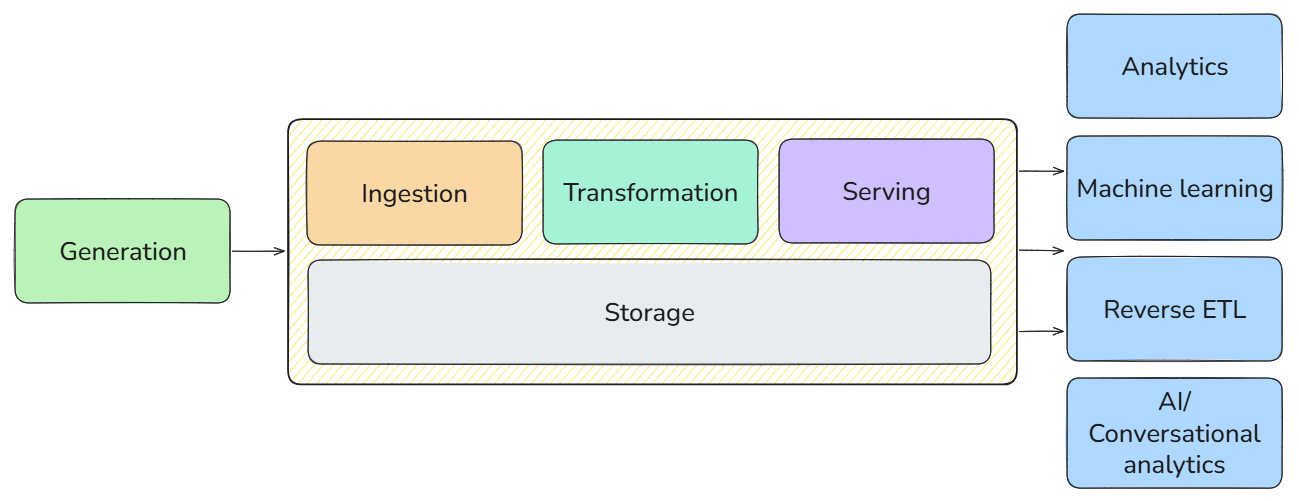
Table of Contents
Generation
Where is the data coming from?
Data can come from many places, such as APIs, files, databases or IOT devices (these are devices that have the ability to connect to the internet and also have the capability of logging actions, this includes smart devices not limited to: fridges, sensors and lights).
Usually the data engineers are not the owners/controllers of the source system, so there are a lot of things to consider:
- Data generation rate
- Volume, how much is coming through?
- Cadence, how frequently is data coming through?
- Data persistence
- How long does it need to remain accessible
- Impact on source system performance when reading data
- Upstream dependencies?
Things that typically go wrong during gestation include:
- Bad data quality
- Schema changes
- System failures/outages
- Access expiring
Ingestion
How is the data extracted and loaded?
There are two major ways that data is ingested, batch or stream. There are some other types such as micro-batch ingestion which is a middle ground between batch and stream, change data capture (CDC), hybrid and a specific API-based ingestion.
Batch ingestion usually is collected and process in groups. This is then run on a schedule or when triggered. It is best for large volumes of historical data and is usually pulled from the source system.
Considerations into batch ingestion usually include how reliable the batches of data come through and how it may impact downstream processing.
Stream ingestion is processed as it arrives. This enables near real-time data updates and is therefore best suited for continuous, time-sensitive data. Data is pushed from the source system through the pipeline.
Considerations into stream ingestion usually includes whether it's actually appropriate to have data upload that often, and if the systems/pipelines can handle extremely busy periods of input, and still output to the same quality.
Transformation
What considerations are there to be made when transforming the data?
This is what the infamous ETL, ELT and EtLT are related to.
ETL - Extract, transform and load
Only store what you need
This is much more common for old process as transformations are required prior to loading due to storage and querying limitations. Usually big data with tools that can't handle it.
ELT - Extract, load and transform
Store everything
This is more common for big data environments such like cloud based storage such as data lakes/warehouses. Especially when transformation is on demand, and unlike ETL it is big data with tools that can handle it.
EtLT - Extract, little bit of transform, load and transform
EtLT includes a little t for non-business logic transformations , such as adhering to compliance and data governance (i.e. deduplication, masking sensitive data, and parsing URL parameters).
But it is advised to have as little t as possible, as the more little t there is, the less the data is closer to the original, and this makes it harder to diagnose later down the pipeline if something goes wrong.
Serving
What are we doing with the data?
This is the actual delivery of the data. But what is important, is how this data will create business value, such as driving insights, predictions, and actions.
There are three main ways that data is presented in the serving stage:
Analytics
This is your usual association with analysing and data. The data can be used for:
- Business analytics – making decisions within or for the business
- Operational analytics – for real-time monitoring and rapid responses
- Embedded analytics – this is the process of integrating data and insights directly into user-facing applications
Machine Learning
Machine learning requires high-quality data for model training. There is a lot more to machine learning with aspects such as feature engineering - which is a data science technique that transforms raw data into a more effective set of inputs for machine learning models.
High-quality data is a key for machine learning and there are many considerations as to where the data is being obtained from in the first place - as it can lead to (inevitable) data biases.
Reverse ETL
Reverse ETL is a relatively newer process in the grand scheme of things, this is the process of feeding transformed data (from the end point) back into operational tools like CRM/ ad platforms which are also known as source systems.
AI/Conversational Analytics
AI is a much newer process where the endpoint of the data can be used for AI applications and models to do analytical processes. By providing both data and context this enables LLMs, chatbots, and AI agents to perform more accurately and provide insights to business users.
Similar to machine learning, this requires high-quality datasets that have enough context for the AI to produce meaningful results.
Storage
How are we keeping this data?
With us being in a lakehouse era, there are now many options to store both structured, semi-structured and unstructured data.
For storage there are general considerations such as how often is this data being accessed, how much is being stored over time, and how is the data being sourced.
Databases and warehouses can be used interchangeably but it is important to distinguish the difference.
Relational Databases vs Data Warehouses
Use and processing:
Relational databases are optimised for CRUD operations (create, read, update and delete) which are great for recording real-time transactions. This is also known as Online transaction processing (OLTP).
Whereas data warehouses are used for the analysis and reporting side using Online analytical processing (OALP), which is optimised for (complex) analytical queries over historical data
Scale and availability:
Relation databases can support thousands of concurrent users and are designed to be highly available with minimal downtime, whereas data warehouses can only support a limited number of concurrent analysts. To maintain it, some scheduled downtime is expected.
Data type & lifecycle:
With relational databases, it is able to handle detailed real-time data, whereas data warehouses is better capable to handle aggregated summarised date. Relational databases sit at the 'generation' phase of the data engineering lifecycle, and data warehouses sit at the 'storage' phase of the data engineering lifecycle.
Data Lake vs Data Lakehouse
Data format & storage
In data lakes you can store raw, unstructured, semi-structured and structured data in its native format. With data lakes, it has schema-on-read flexibility, which means that schemas are only applied when the data is read or queried, rather than when it's written.
Compared to data lakehouses which combines the raw storage of the lake with structured layers which supports schema enforcement.
Query performance
Data lakehouses are optimised for high-throughput batch loading. However because of this optimisation, slower query times can be experienced, especially for complex analytics.
In contrast, data lakehouses feature high-performance query engines which are capable of fast and interactive SQL analytic workflows. In addition to this, the query engines are also capable of machine learning workflows too.
Data governance
It is difficult to enforce many aspects, such as strict data quality and fine-grained access control (which is a security model that grants or denies permissions based on multiple conditions and context rather than user roles alone). In addition to this ACID (atomicity, consistency, isolation, durability) transactions are difficult to enforce which leads to 'data swamps' where data is transferred without quality checks, governance, ownership which can make the data seem difficult or untrustworthy to use.
But once again to contrast this, in data lakehouses these issues are less likely to happen with ACID transactions, absolute data quality controls, historical versioning and enterprise-grade security being available.