


In my last blog post, I discussed how knowledge of data structures can be helpful in the process of data preparation (e.g. cleaning, reshaping, etc.), but the other aspect of data analytics work-–that tends to receive the most coverage—is data analysis. Data analysis is a conglomeration of hard and soft skills that (us) data analytics consultants employ to help people make sense of their data. However, in layman’s terms, data analysis can be broken into 2 main buckets:
- Data Visualization
- Building dashboards and reports based on user needs.
- Generating charts and graphs that answer specific questions.
- Data Communication
- Comprehending and succinctly verbalizing trends and patterns relevant to your user.
- Using discovered insights to help inform a user’s decision.
Of course, for each of these definitions we can go into much greater detail, but the main takeaway is that data analysis is the practice of translating the language of data (verbally and/or visually) to inform arguments, decisions and strategies.
Tools
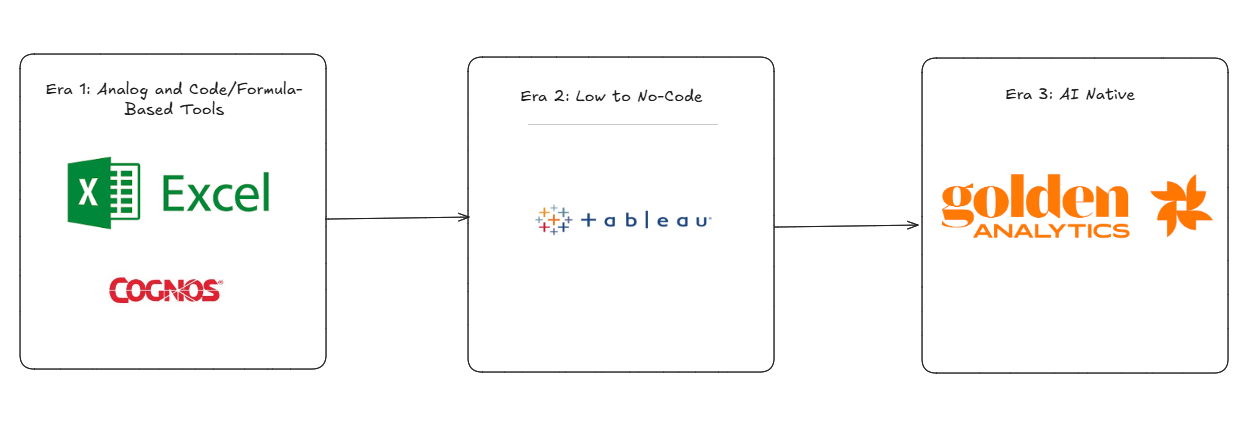
Data analysis has been around for ages, but the tools that we use to conduct the technical work of analysis, such as chart generation and calculations, have changed over the decades. But, as we enter a new era where AI-native technologies are becoming the norm across many private and public sectors, it begs the question of how AI analytics tools will influence the work and landscape of data-based professions.
AI-Native BI Tools and The Implications
Recently at The Information Lab, we had the wonderful opportunity to speak with the founder of Golden Analytics, Francois Ajenstat. Golden Analytics is an AI-native business intelligence tool that, not only lowers the barrier of entry into data analytics, but leverages the power of LLMs to optimize the efficiency of data analysis.
One of the most unique aspects of Golden Analytics that Francois emphasized was: the slider of autonomy. The slider of autonomy isn’t a tangible slider, but, essentially a type of human-computer interaction, that gives the user agency over how much technical data analytics they do within the software. Throughout the tool an AI chatbot is embedded to assist the user at whatever step they’re on (e.g. chart creation, dashboard building, report writing, etc.). As a result, individuals who have less experience in data can mobilize the chatbot to chat with their data, manipulate their graphs and even help communicate relevant trends and patterns to the end user. One could even build a whole dashboard from a prompt! Although the LLM integration is still in progress, the primary benefit is that individuals with domain knowledge or expertise in non-data fields (e.g. business, healthcare) can break into data analytics to enhance their practice or institution.
However, on the other side of the autonomy spectrum, for those who love to build graphs and dashboards from scratch, Golden’s interface has drag and drop mechanisms quite similar to Tableau’s that one could use to construct the necessary visualizations for their analysis! The beauty of being able to work within this spectrum of autonomy as a data analyst is that it increases the efficiency of our workflow. Tedious tasks such as creating complex calculated fields and dual axis charts can be completed almost instantaneously because our conceptual data knowledge effortlessly informs the technical requirements. Thus, the potential for magnitude of output, that now lay in the hands of data analyst, increases exponentially with a tool like Golden Analytics.
What does this mean for the field?
When I first asked Francois this question, he answered with extreme optimism. He suggested two main ideas:
- Since the tool will improve data analysts’ efficiency, we could spend more time conducting the thoughtful and logical work of understanding the data to communicate it to our stakeholders.
- Due to improved efficiency and output, the demand for data analysts will increase.
I am pretty confident that the first idea—assuming that this technology is the future of business intelligence—will come to fruition. Honestly, the data communication aspect of the work is some of the most satisfying because helping people understand the numbers unlocks an entirely new dimension in their work; decision making becomes more sound. However, I am somewhat skeptical about his second proposal. A forecast from Informatica suggest that data engineering is a growing field and, if the age of AI is the newest technological era, then the field of data analytics/data science will continue to rise in prominence. But, one can’t help to inquire if AI analytics tools will shrink demand for data analysts rather than increase it. If tools like Golden Analytics allows one data analyst to do the same amount of work as five (with the current industry standard tools) then what’s the point of having a team of ten? I’m not trying to be pessimistic about the future of my field but as a data analytics consultant I am trained to ask the relevant questions.
Luckily, we are still in the early stages of AI, so my concern isn’t too great yet. As I am undergoing training, I am excited to learn more data engineering techniques.