


Before starting data engineering training, I'd heard the term medallion architecture and people referring to bronze, silver and gold layers, but I never really knew what any of it meant. So when it came up in training, I wanted to properly understand what medallion architecture actually is and why it's used.
What is medallion architecture?
Medallion architecture is a way of structuring data into layers, so raw data is processed step by step into clean, refined data that's ready for analysis, reporting or machine learning. Splitting it into layers also makes the data more modular, so each layer has its own job. It typically has three layers:
- Bronze: the raw data, landed in its original format with as few changes as possible. It's kept as a historical record, so you always have the original data to go back to.
- Silver: the data is filtered, cleaned and standardised. This is where missing values are handled, data types are set, different sources are brought together and keys are applied.
- Gold: the data is curated and business ready. It's shaped around what the business needs, like agreed measures and models built for reporting and dashboards.
Medallion architecture through a furniture analogy
A good way to understand the layers is to compare them to building furniture, so thanks to Ed Hayter for this analogy, as it really helped it make sense for me.
Bronze is your raw materials: the planks of wood, nuts and bolts. On their own they're not much use to anyone, but you need them to build anything, and you want to keep them as they are.
Silver is using those raw materials to build furniture, like chairs and shelves. Each piece has been put together properly and is ready to be used, but nobody has asked for anything specific yet.
Gold is when a stakeholder comes to you and asks for a living room. Because you've already built the furniture in silver, you have everything ready to go, so you can put the room together quickly instead of starting from the planks of wood every time.
What this looks like in practice
dbt is a great way to see medallion architecture in action, because its lineage graph shows how data flows from left to right through each layer:
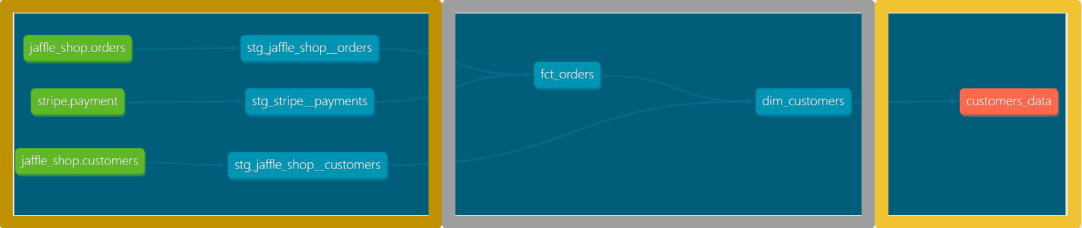
- Bronze: the green boxes are the raw sources, like jaffle_shop.orders, and each one feeds into a staging model starting with stg_. Staging is where you only do light tidying, like renaming columns, fixing data types and selecting the columns you need.
- Silver: fct_orders and dim_customers are fact and dimension models, where the main transformation happens and the structure of the data is set.
- Gold: customers_data is the business ready output, built from the silver models for a specific use.
It also shows who usually does what. Data engineers land the raw data and build reliable pipelines from bronze to silver, and analytics engineers shape silver into gold, so the data is modelled, tested and documented for analysts to use.
Why use it?
Going back to the furniture, the layers give you a few big advantages. If something goes wrong in gold, your raw materials are still safe in bronze, so you can always rebuild. Each layer is also a checkpoint where you can spot problems with the data and work out what caused them, and having clear layers makes it easier to see who owns what.
There are some downsides to consider too, so keeping three layers means storing more data, which costs more, and the data has to pass through every layer, which takes longer. Each layer can also involve different tools and processes, so it needs skilled people to set it up and maintain it, which means it's worth thinking about whether the benefits outweigh the costs for what you're building.